Material properties such as permeability, impedance spectra and conductivity are measured over wide frequency ranges and on samples of many shapes. The tasks below come from labs working on EMC absorbers, amorphous magnetic materials, geological samples and inductor materials.
Typical test tasks
| Test task | Sample | Typical test conditions | Recommended set-up |
|---|---|---|---|
| Complex permeability of absorbing materials | Ring-shaped samples of EMC and shielding materials | 2 kHz – 30 MHz, 500 mV; real and imaginary part, frequency sweep | TH2851 precision impedance analyzer with TH26086 adapter base, TH26088 permeability fixture and permeability software |
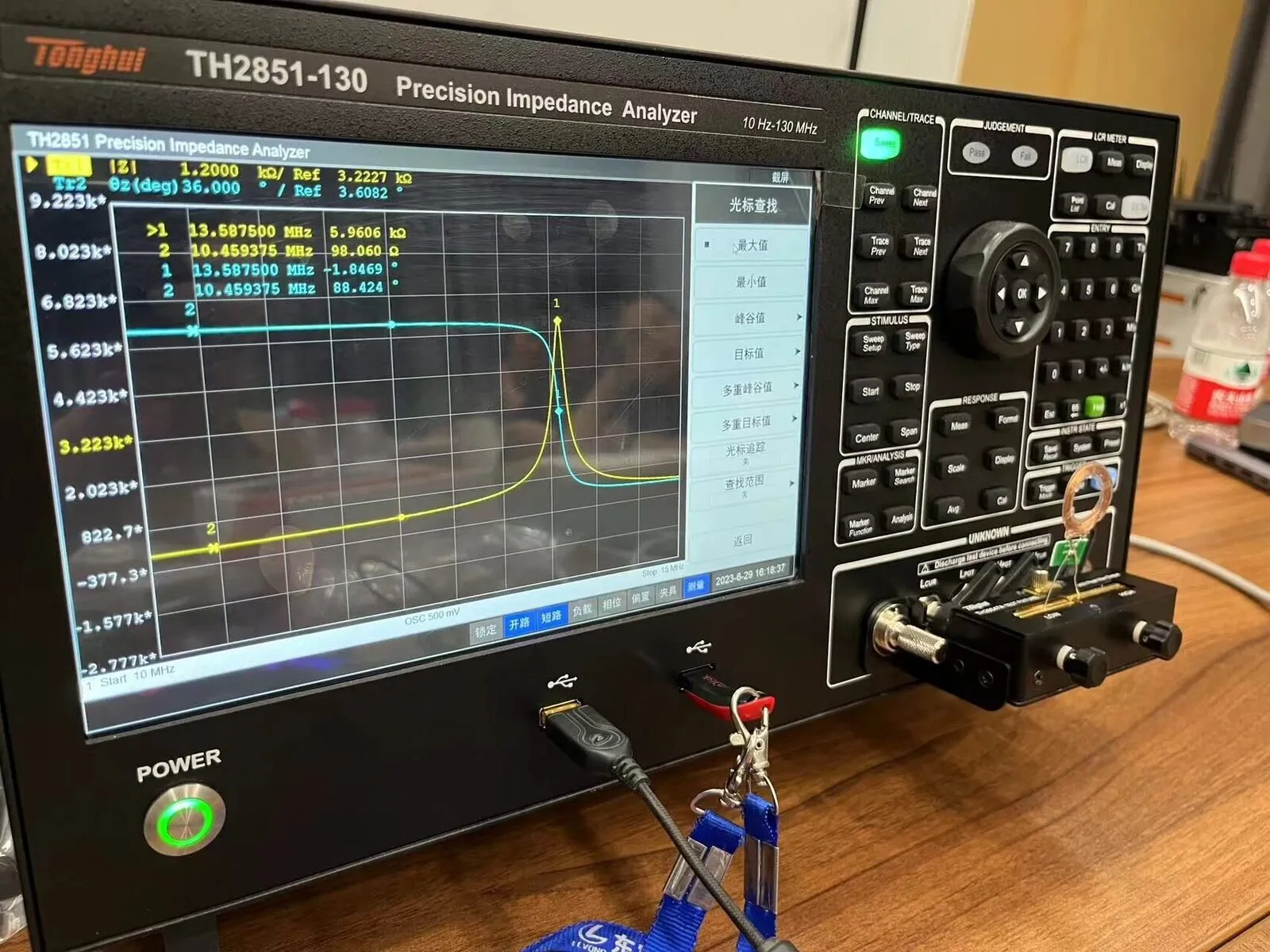
| Impedance of amorphous magnetic cores | Bare and encapsulated rings | 50 Hz – 130 MHz at 100 mV; bare rings at 530 kHz, 10 MHz, 20 MHz and 30 MHz; impedance curves for encapsulated rings | TH2851-130 precision impedance analyzer |
| Conductivity of rock samples | Geological samples | Two- or four-electrode method, 4 Hz – 10 MHz | TH2848 precision impedance analyzer or TH2851 with TH26011BS 4-terminal leads. For a narrower frequency range: TH2838 |
| DC-bias characteristics of inductor materials | Inductors and magnetic cores | 100 kHz, bias 1–5 A in 10 steps; inductance and Q | TH2840B/BL LCR meter with TH1779A DC bias current source |
What to consider
- Fixture first. For permeability, the fixture and the sample geometry decide the accuracy as much as the analyzer. Tell us your sample sizes.
- Frequency range. Choose the analyzer version by the highest frequency you need, with some margin.